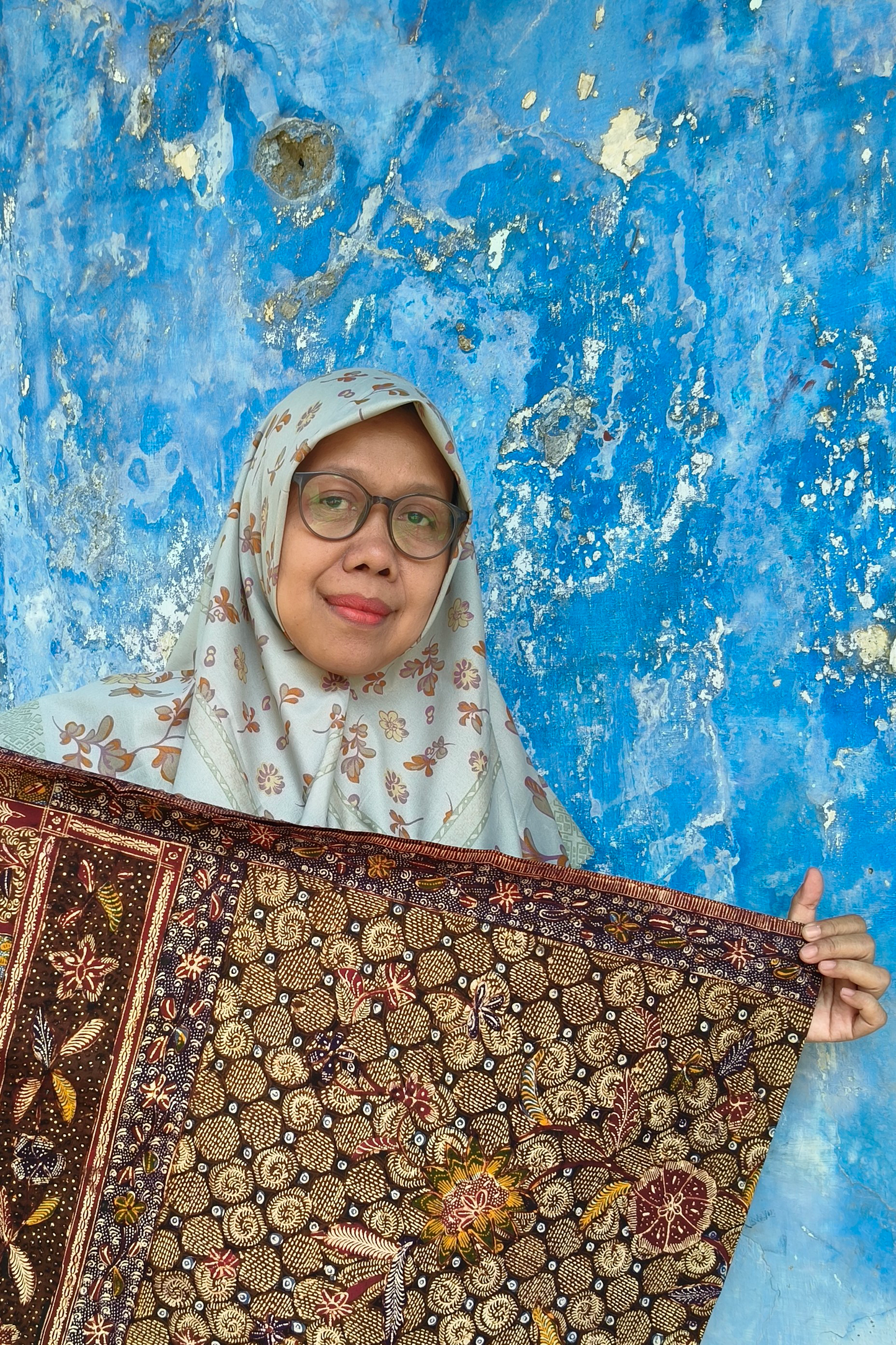
Ibu Mas Ulafah
IBU MAS ULAFAH, SARONG KAWUNG ENDHOG
IBU MAS ULAFAH, SARONG KAWUNG ENDHOG
Couldn't load pickup availability
Ibu Mas Ulafah
Born 1981, Batang, Indonesia
SARONG KAWUNG ENDHOG (2025)
100% Cotton, synthetic dyes
Hand-drawn wax resist on machine-woven cotton
216 X 104cm
This richly coloured and detailed sarong brings Rifa'iyah interpretations to ancient designs with dazzling results.
This sarong is made in the tiga negeri (three nations) style, where the wax motifs are applied to the cloth three times over, once for each dye bath — a process demanding patience and precision. The three colours were each historically sourced from a different centre of Javanese batik production: red from Lasem on the north coast, blue from Pekalongan, and brown from Solo.
The badan (body of the cloth) is composed of the kawung endhog design — a geometric pattern of circular forms, each comprised of sasek (curling forms) or fine lines, creating subtle variation across the repeating grid. Kawung refers to the fruit of the sugar palm; the motif is said to symbolise the four elements — wind, water, fire and earth — and our origins within them. It is one of the oldest motifs in Javanese visual culture, found in the stone reliefs of Hindu-Buddhist temples, and was historically among the larangan — forbidden patterns reserved for the royal courts. Endhog means egg, the oval forms evoking the renewal of life.
Against this background emerge vines of flowers and foliage, among which abstracted birds are concealed — constructed from feather-like leaves, or leaf-like feathers, so that the boundary between creature and plant dissolves entirely. This is the samaran principle at work: living beings are never depicted whole, in keeping with the Rifa'iyah Sufi teaching that a living creature must not be shown in full unless one can also grant it a soul.
Border panels are filled with cecek (dots) and biji kedawung — the seeds of the kedawung tree (Parkia roxburghii), long prized in traditional Javanese herbal medicine. Like other seed-based fill motifs in Rifa'iyah batik, biji kedawung carries connotations of health, abundance and the healing properties of the natural world.
The kepala (head section) is worked in the elaborate pelaraan design — stylised coconut palm fronds arranged within a geometric composition of intersecting tumpal triangle forms. Coconut palms hold a prominent place in Javanese ceremonial life, their fronds woven into decoration for weddings and celebrations; the motif brings blessings, protection and the sweeping away of misfortune to the cloth and its wearer.
Ibu Mas Ulafah (Ibu Uul)
Ibu Uul has practised batik tulis since the age of twelve — beginning simply by watching others before taking hold of the canting herself and never looking back. She learned from her great-aunt and other relatives, and has since mastered most forms of Rifa'iyah motif, including classic two-colour relawati combinations and the intensive three-stage tiga negeri dye process.