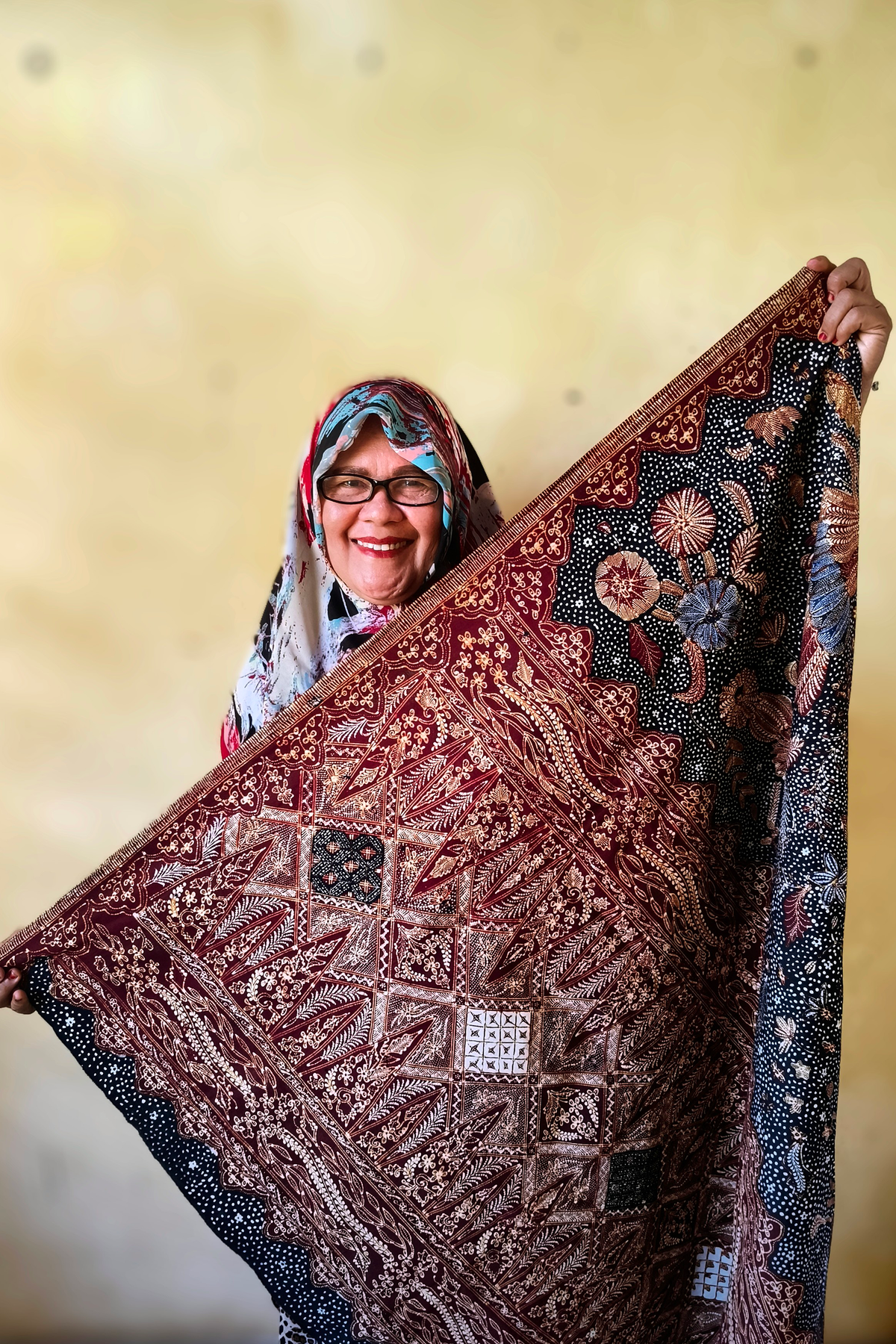
Ibu Mulyati
IBU TRIHANDAYANI MULYATI, SARONG RELAWATI BERAS WUTAH
IBU TRIHANDAYANI MULYATI, SARONG RELAWATI BERAS WUTAH
Couldn't load pickup availability
Ibu Trihandayani Mulyati
Born 1985, Batang, Indonesia
SARONG RELAWATI BERAS WUTAH 2025
100% Cotton, synthetic dyes
Hand-drawn wax resist on machine-woven cotton
216 × 114 cm
Rendered in two colours in the Relawati style, the badan (body of the cloth) carries rich symbolism.
At its centre are two abstracted manuk merak, peacock-like figures constructed from foliage, plumage-like leaves and leggy branches. In Javanese and Chinese-influenced coastal batik, the peacock (merak) is the king of birds, associated with beauty, prosperity and good fortune. Depicted as a pair, the birds carry an additional meaning of coupledom and harmony. These abstracted creatures are woven into a larger bouquet composition, lumbungan or kembangan, in the samaran style that is the hallmark of Rifa’iyah batik. Elsewhere across the badan are small bird-like bouquets, tiny flowers and insect-like creatures constructed of leaves and petals — never quite complete, in keeping with the samaran principle.
The background fill is beras wutah — literally ‘spilled rice’ or ‘scattered grains’ — a fine motif of small grain-like forms scattered across the ground of the cloth. In Javanese ceremony, the scattering of uncooked rice grains is a ritual gesture invoking rezeki yang berlimpah (abundant fortune and overflowing blessings) offered to newlyweds and at other auspicious occasions as a prayer for prosperity.
The kepala (head panel) features the gigi walang border — the ‘grasshopper’s teeth’ motif, a serrated or saw-tooth pattern that is one of the most widely used protective borders in Javanese batik. Though the grasshopper is small and unassuming, its teeth can devastate entire crops; the motif thus carries the symbolism of surprising inner power and the Sufi virtue of tawadhu’ (humility), the understanding that true strength is often found in the quiet and the overlooked. In Rifa’iyah batik practice, gigi walang is more commonly associated with the materos style, so its appearance here in a Relawati piece is a creative departure from convention.
The gigi walang triangular forms are filled with pelaraan — the coconut palm frond motif, used as ceremonial decoration at Javanese weddings and blessings to invoke protection and sweep away misfortune. It is accompanied by kembang mlinjo or uceng — the flower clusters of the melinjo tree (Gnetum gnemon), a tree central to Javanese ceremonial food culture whose distinctive blossoms carry associations with abundance and communal celebration.
Bordering the kepala panel are kembang mangga (mango flowers), associated in Javanese tradition with abundance, auspiciousness and the sweetness of good fortune, alongside kembang sirih, the flowers of the betel vine, renowned for their medicinal and ceremonial significance.
The entire cloth is bordered with boh gunungan — a mountain-profile border derived from the gunungan of Javanese shadow puppetry (wayang kulit). The gunungan is the ornate, pointed form that the puppet master raises to open and close every wayang performance — a representation of the universe, the tree of life, and the axis connecting the earthly and spiritual realms. Its tapering, upward-pointing form represents the aspiration of all life toward God.
This work exhibited internationally in the 2026 exhibition, Batik Rifa'iyah: Be Immersed.
Ibu Trihandayani Mulyati (Ibu Yati)
Growing up in Magelang, Ibu Mulyati, known by friends as Ibu Yati, learned batik tulis in the Solo style while still in primary school, and later became familiar with Rifa’iyah motifs after moving to Batang and marrying into a Rifa’iyah family. She loves to innovate with every piece through unusual colour combinations, unexpected fills or novel motif pairings. Her works carry stories and intentions for the wearer: hopes and prayers that they may lead a happy, if modest, life, and share whatever joys they are given with those around them.