Ibu Hidayat
IBU HIDAYAT, JARIK PAGI SORE GEMBLONG SAIRIS LANCURAN
IBU HIDAYAT, JARIK PAGI SORE GEMBLONG SAIRIS LANCURAN
Couldn't load pickup availability
Ibu Hidayat
Born Batang, Indonesia, 1976
JARIK PAGI SORE GEMBLONG SAIRIS / LANCURAN (2025)
100% cotton, synthetic dyes
Hand-drawn wax resist on machine-woven cotton
250*102cm
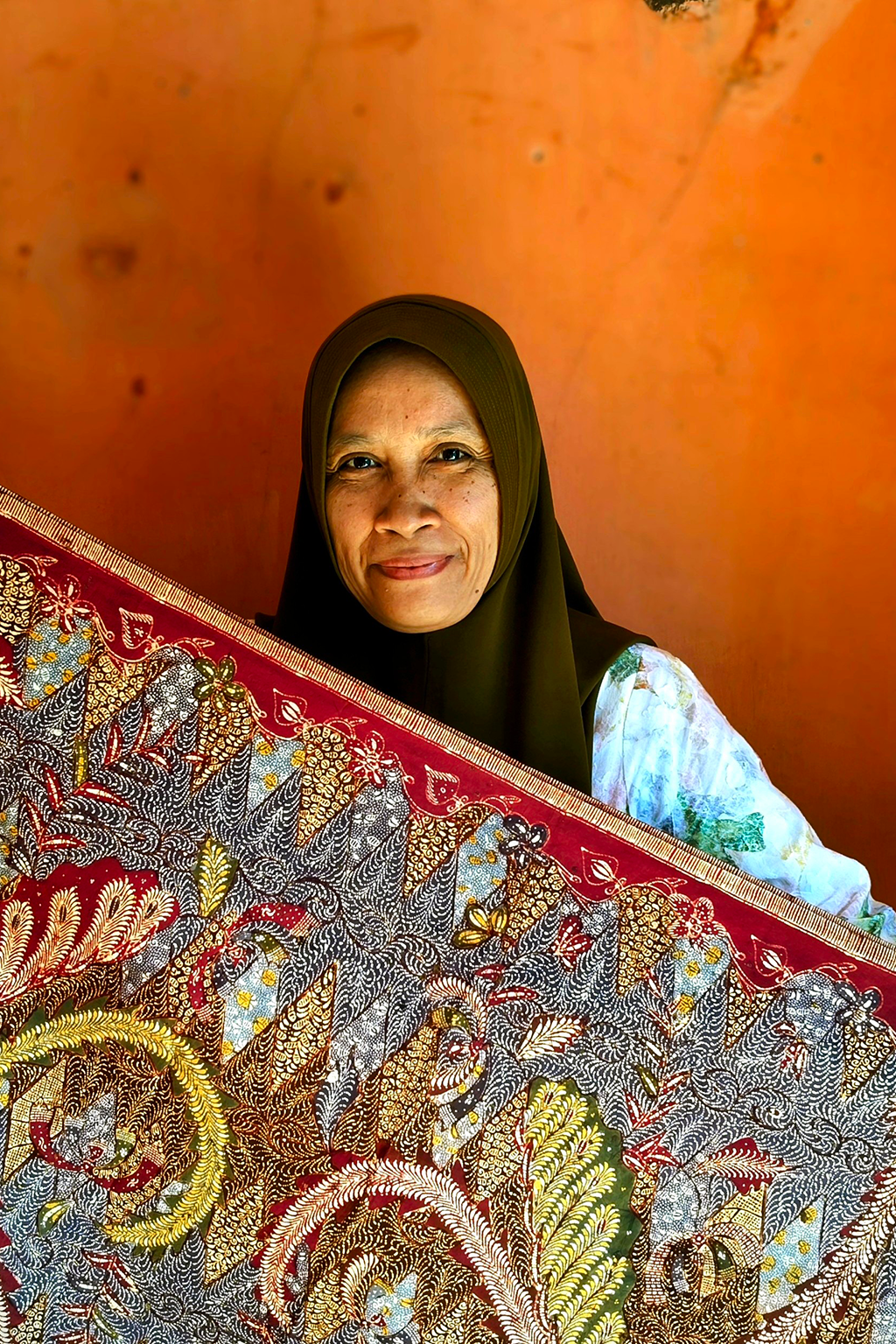
Overflowing with symbolism, exquisite detailing and use of colour, this batik cloth illustrates diversity and interconnectedness in the natural world.
This long jarik piece balances contained geometric order with free-flowing botanical forms, and reveals, on close inspection, a world of abstracted creatures hidden in plain sight. Made in the pagi-sore (morning-evening) format, where one half of the cloth is intended for morning wear and the other for evening, is as rich in symbolism as it is in its variations of motif and colour.
The left panel presents a complex, botanical patchwork divided by sinuous foreground bouquets of plants and flowers. Each compartment is filled with a different isen-isen (fill motif): krokotan (purslane leaves), a variety of abstracted seeds, vine-like delicate materos tendrils and sisik (fish-scale) forms. This natural, patchwork-like composition shares similarities with the Central Javanese motif sekar jagad — meaning, literally, ‘flowers of the universe’. In the sekar jagad tradition, the cloth is understood as a map of the world’s beautiful diversity: different patterns within each compartment represent different botanicals, ecologies and ways of being, all of which are intrinsically interlinked.
The right panel features gemblong sairis. The name is grounded in the everyday: gemblong is a traditional Javanese sticky rice cake made from glutinous rice flour coated in palm sugar (tepung ketan berlapis gula aren), and sairis (or sak iris) means ‘one slice’. The motif takes its geometric form from the cross-section of the cake when cut: a repeating pattern of lozenges and diamonds that is at once humble in its inspiration and extraordinary in its execution.
Overlaying this geometric ground are abstracted burung merak — peacocks. Across Java’s north coast batik tradition, the peacock is considered the king of birds: a symbol of beauty, strength, grace and elegance in daily behaviour and attitude. Its spectacular tail has long been associated with fame, good fortune and heightened awareness. In Chinese-influenced coastal Javanese batik — of which Rifa’iyah is a part — the peacock carries additional associations with prosperity, protection and warding off bad luck. In Ibu Hidayat’s working, the peacock-like creatures dissolve into tendrils, its feathers become foilage, and bodies are adorned with sisik (fish scales). This is the Rifa’iyah practice of samaran — camouflage or abstraction — in its most sophisticated expression. The teachings of Kyai Ahmad Rifa’i, drawn from his Sufi reform text Tarajumah, hold that living creatures must not be depicted in their entirety unless the artist is also able to grant them a soul.
Both panels enact the same exquisite visual tension: the interplay between contained geometric backgrounds — the orderly gemblong sairis diamonds, the structured compartments of the pagi-sore format — and the free-flowing, softer foreground of flowers, tendrils and abstracted creatures. It is a cloth that holds chaos within form, and finds freedom within structure. This is not merely an aesthetic choice: in Sufi thought, the discipline of the outward form creates the conditions for inner liberation.
The border of the cloth brings together several protective elements: abstracted udang samaran (camouflaged shrimp, rendered in the samaran style as curved, suggestive forms), trailing vines, small tumpal (sacred triangles, symbolising cosmic order and the peaks where earthly and spiritual realms meet) and sisik (scale motifs). Together these create a layered protective barrier around the wearer — each element contributing its own symbolic power to the whole.
The colour scheme is an exceptional, complex variant of the prestigious tiga negeri (three nations) process — in which the cloth is dyed three times, each stage requiring the entire wax motif to be re-applied. Traditionally, each of the three dye colours came from a different Javanese centre: red from Lasem on the north coast, blue from Pekalongan, and the warm brown sogan from Solo. This multi-stage, multi-location process makes tiga negeri the most technically demanding and most prestigious of all Rifa’iyah batik colourways.
Ibu Hidayat’s cloth goes further still, incorporating additional tones of green, light blue, black and yellow into the colour scheme — a creative expansion of the tiga negeri foundation that results in a uniquely complex palette and distinguishes this piece from most other tiga negeri works. The result is a cloth of rare chromatic richness.
Ibu Hidayat
Born and raised in Batang, Ibu Hidayat learned the art of batik tulis from her mother, beginning at the age of ten — a tradition passed down through the generations of her family. For Ibu Hidayat, batik is not simply a craft but a matter of identity: a living connection to custom, community and the spiritual practice of the Rifa’iyah. She is drawn to motifs inspired by the unfurling of nature such as lancuran (rooster tail feathers) and materos (interconnected vines).