Ibu Nur Faidah
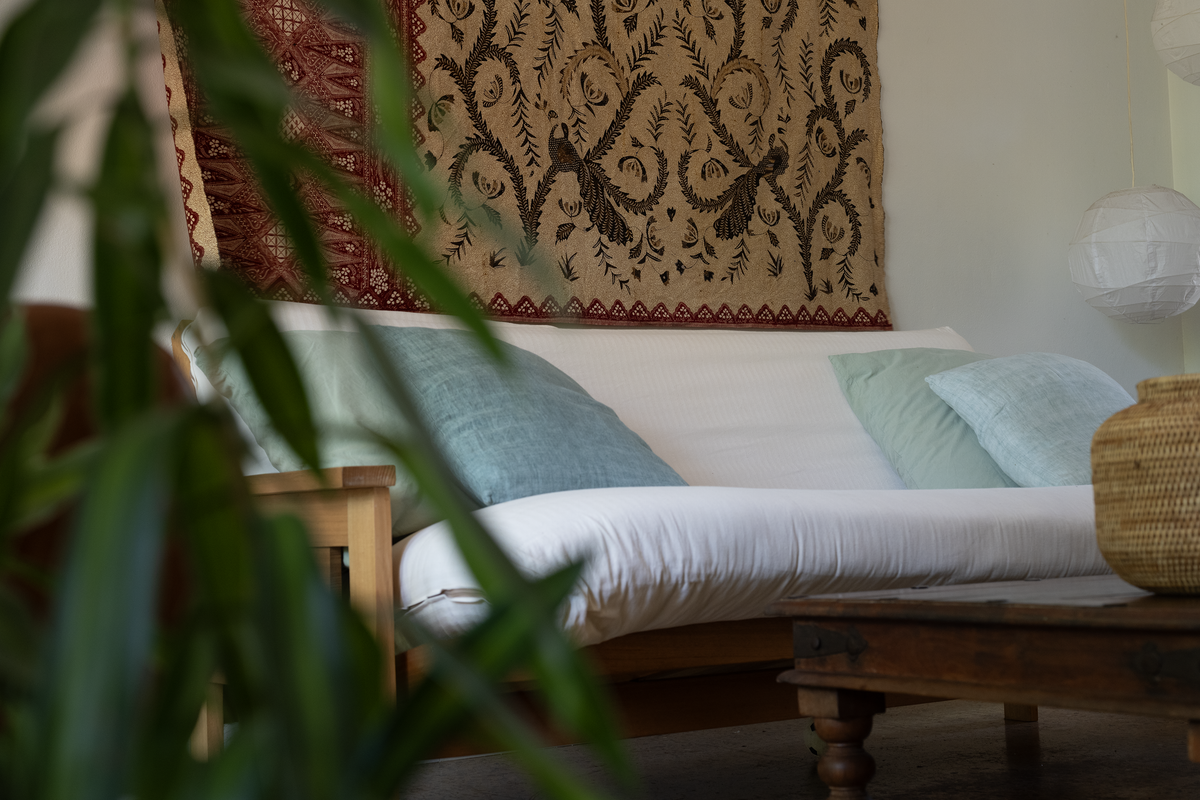
IBU NUR FAIDAH, SARONG MATEROS MANUK MERAK
IBU NUR FAIDAH, SARONG MATEROS MANUK MERAK
Couldn't load pickup availability
Ibu Nur Faidah
Born Batang, Indonesia, 1980
SARONG MATEROS MANUK MERAK
2007
100% cotton, synthetic dyes
Hand-drawn wax resist on machine-woven cotton
216 x 114cm
A work of incredible precision created over many months, this sarong hip-wrapper is a rare beauty.
The background of this materos sarang appears, from a distance, to be blank. On closer inspection, however, we see that it is covered in an extraordinarily fine field of ukelan — tiny, spiralling vine-like curls drawn with the lightest possible stroke of the canting. This level of fine work is among the most technically demanding in Rifa’iyah batik, achievable only by artists with exceptional control and patience. It draws the eye first to the foreground composition, and then, as the viewer steps closer, rewards them with a second layer of revelation, where the ground itself comes alive.
The style takes its name from Mrs Matheron (née Willemse), a Dutch-descended batik merchant in Banyumas, Central Java, who inherited the workshop of her aunt, Mrs Catharina Carolina van Oosterom (1816–1900), one of the influential Dutch entrepreneurs who shaped Java’s north coast batik industry in the 19th century. Her batiks became so celebrated that the style was named after her (batik matheron or materos) characterised by fine, intricate vine-like fills, often on a light or apparently plain background. The style was copied in Pekalongan by the 1920s, and eventually reached Batang, where the Rifa’iyah community absorbed it and imbued it with Sufi spiritual meaning. The interconnected vines are seen as a symbol of the kinship ties and relationships through which prosperity flows.
The foreground features two burung merak (peacocks), rendered in the samaran style: their heads detached, their bodies and tail plumage constructed from long leaf forms, almost symmetrical but not quite. These careful deviations from perfect symmetry are intentional. In the Rifa’iyah tradition, the deliberate introduction of a stylised flaw is the artist’s act of deference to the true Creator, a quiet acknowledgement that only God may achieve perfection. The peacock itself carries rich symbolism across Javanese and Chinese-influenced coastal batik: beauty, grace, prosperity and good fortune; depicted as a pair, harmony and coupledom. Elsewhere, smaller manuk samaran (abstracted birds) flutter through the design, honouring the samaran principle that no living creature may be depicted whole unless the artist can also grant it a soul.
The kepala (head panel) is richly worked in the gigi walang (grasshopper’s teeth) border motif, its serrated forms filled with kramikan (tile-like geometric forms), pelaraan (coconut palm fronds, invoking ceremonial blessing and protection), jasmine flowers and further botanical detailing. The jasmine, sacred in Javanese ceremony, its white blooms associated with purity, sincerity and the divine, is a fitting companion to the gigi walang’s symbolism of inner strength found in the modest and overlooked.
The entire cloth is bordered by mancungan, a mountain-like design decorated with flowers. In Javanese cosmology, the mountain (gunung or meru) is the axis mundi: the centre of the universe, home of the gods, ancestors and supernatural beings, and the place where earthly and spiritual realms converge. As a border encircling the entire cloth, the mancungan places the wearer at the sacred centre, enclosed and protected by the cosmic mountain and all the blessings it represents.
This piece was exhibited internationally at the Batik Rifa'iyah: Be Immersed show in August 2026. Created on extra fine cotton, this piece is delicate to hold and has a few tiny natural holes.
Ibu Nur Faidah
Ibu Faidah learned batik as a young girl, taught by female relatives while growing up in Batang. Her work stands out not only for its fine detailing but for the care she brings to the overall composition. She loves the interplay between free-form and geometric designs, and is a master of the materos motif.