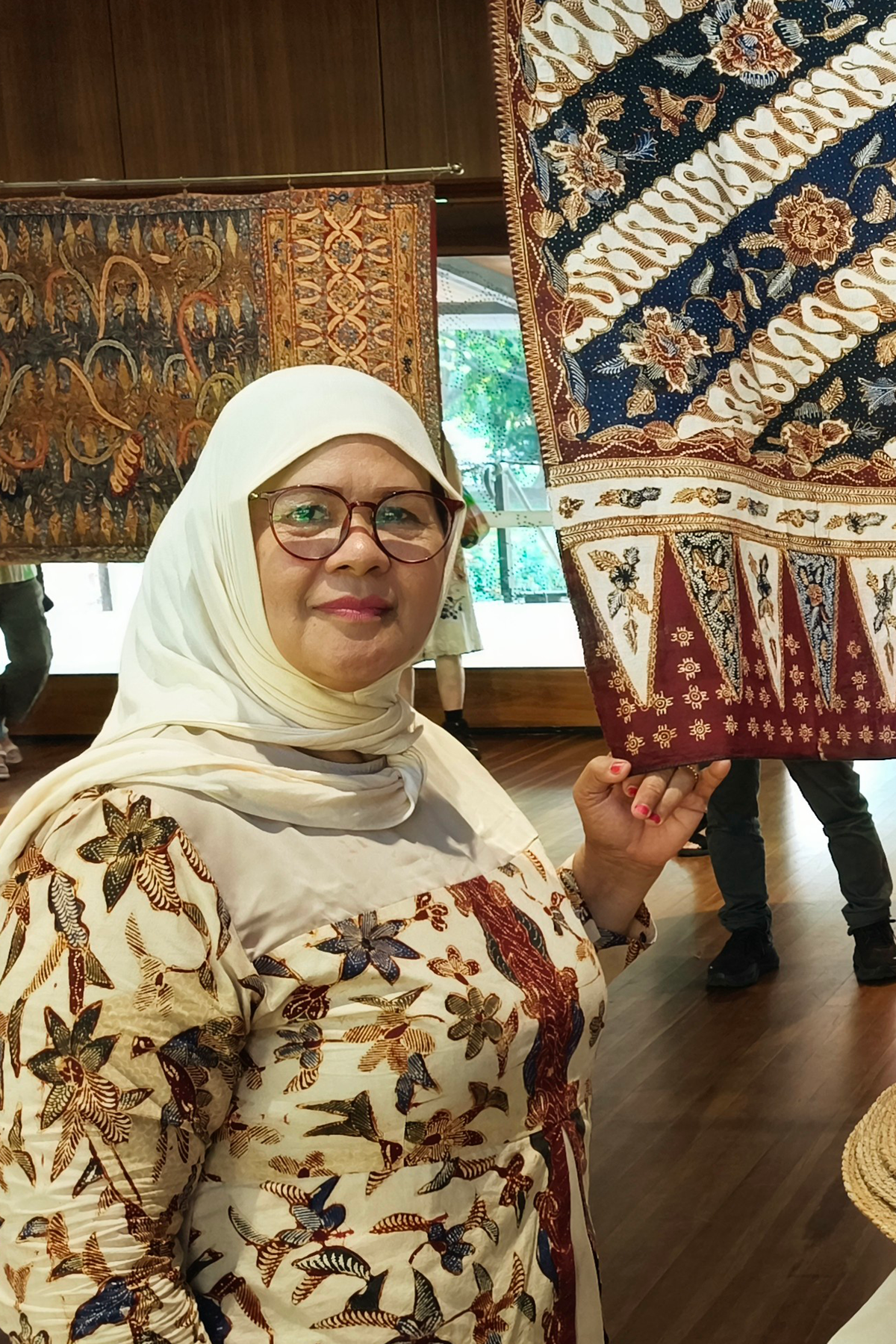
Ibu Mulyati
IBU MULYATI, SELENDANG PARANG RELAWATI
IBU MULYATI, SELENDANG PARANG RELAWATI
Couldn't load pickup availability
Ibu Trihandayani Mulyati
Born 1963, Batang, Indonesia
SELENDANG PARANG RELAWATI (2025)
100% Cotton, synthetic dyes
Hand-drawn wax resist on machine-woven cotton
230 x 54 cm
This selendang is a synthesis of two distinct Javanese batik traditions, the Rifa’iyah style of Batang’s north coast and the classical inland style of Solo.
This unique combination reflects the artistic background of its maker as Ibu Yati was born in the inland region of Magelang and moved to Batang, on the north coast of Java, as an adolescent.
The cloth is composed of diagonal alternating sections of two contrasting designs. The first is a stylised parang rusak, literally ‘broken parang’ or ‘broken knife’ — one of the larangan (forbidden) motifs of the royal courts of Yogyakarta and Surakarta, historically reserved for the royal family and believed to carry symbolic power, wisdom and cosmic energy.
Here, however, the parang rusak takes on a distinctly Rifa’iyah character. The bands are rendered as fish-like tails, with leaves replacing the circular elements of the classical composition.
The alternating diagonal sections are worked in the Relawati style with animated floral bouquet compositions characteristic of Rifa’iyah batik. These wild arrangements of leaves and flowers create a vivid contrast with the geometric parang rusak, a more stylised and contained motif.
The ends of the selendang (the kepala or head sections) feature tumpal filled with sasek (fern-like curling forms) and flowers. The tumpal — triangular forms symbolising creation, the cosmic mountain and the aspiration of all life toward the divine — are accompanied by star-like configurations along the outer lengths of the cloth, suggesting the celestial realm beyond the earthly horizon.
The body of the selendang is bordered by stylised udang samaran — abstracted shrimp rendered as curving, undulating forms in keeping with the Rifa’iyah samaran principle — and bunga mlinjo (also known as uceng), the delicate flower clusters of the melinjo tree (Gnetum gnemon), a tree central to both Javanese ceremonial food and everyday snacks.
This artwork exhibited internationally at the Batik Rifa'iyah: Be Immersed exhibition as part of Darwin Festival 2026.
Ibu Trihandayani Mulyati (Ibu Yati)
Ibu Trihandayani Mulyati, known to friends as Ibu Yati, grew up in Magelang, where she learned batik tulis in the Solo style while still in primary school. After moving to Batang and marrying into a Rifa’iyah family, she became deeply familiar with the coastal tradition, and it is the creative tension between these two worlds that animates much of her work. This selendang, drawing together the royal parang rusak of the Javanese courts and the free-flowing Relawati of the coast, is a perfect expression of that fusion.