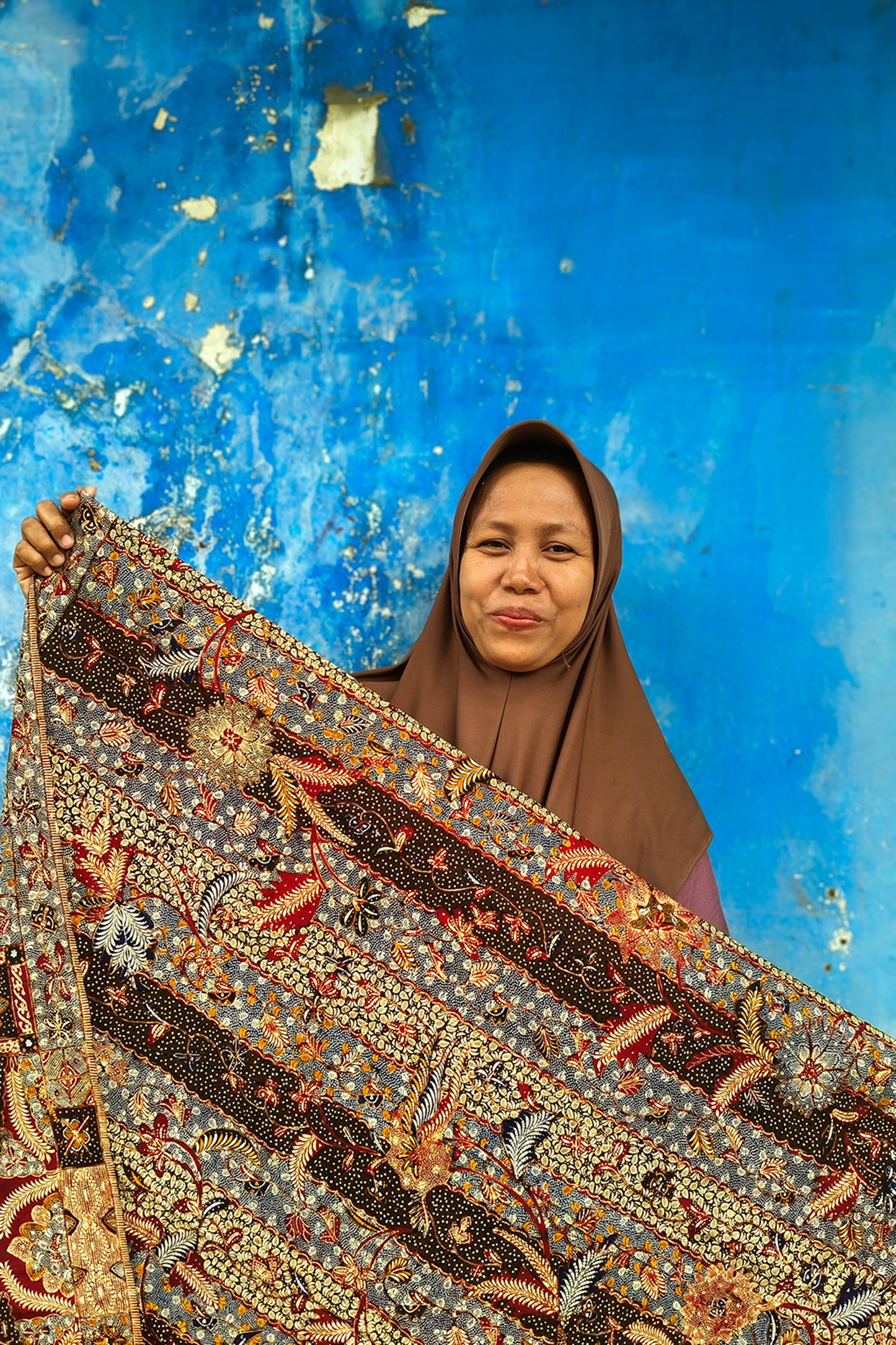
Ibu Mustofiyah
IBU MUSTOFIYAH, SARONG DLORONGAN
IBU MUSTOFIYAH, SARONG DLORONGAN
Couldn't load pickup availability
Ibu Mustofiyah
Born 1985, Batang, Indonesia
SARONG DLORONGAN (2025)
100% Cotton, synthetic dyes
Hand-drawn wax resist on machine-woven cotton
210 x 114cm
An exceptional piece of rich colouring and detail in the rare dlorongan style.
This sarong is worked in dlorongan, which is a Rifa'iyah motif characterised by thick vertical running bands, each filled with a different repeating botanical or geometric element.
Made in tiga negeri (three nations) colours, the wax motifs were applied to the cloth three times over, once for each dye bath — a process of extraordinary patience and precision. The three colours were each historically sourced from a different centre of Javanese batik production: deep red from Lasem on the north coast, blue from Pekalongan, and rich brown from Solo. Here, touches of yellow, green and light blue add further complexity and depth to an already vibrant palette.
The foreground is animated by abstracted birds interwoven with flowers and foliage — ayam-like figures worked into elaborate bouquet compositions of leaves and blooms, their forms constructed from leaves and tendrils in the samaran style. In keeping with the Rifa'iyah Sufi principle that living creatures must not be depicted in their entirety unless the artist can also grant them a soul, these birds are never quite complete — present in the composition, yet dissolved into it.
Each band of the dlorongan is filled with fine botanical isen-isen (fill motifs) including a design inspired by polong kedawung — the distinctive elongated pods of Parkia timoriana, whose antioxidant-rich seeds are valued in traditional Javanese medicine — alongside ukel materos (hook-like curling forms) and cecek / tutul-tutul (tiny, evenly spaced dots drawn with the canting).
The kepala (head panel) is worked in the pelaraan motif — sweeping coconut palm fronds that invoke the ceremonial frond decorations of Javanese weddings and blessings, carrying associations of spiritual protection, prosperity and the sweeping away of misfortune.
The vertical side panels are bordered with a delicate chain of kembang sirih — the slender flower spikes of the betel vine, renowned for their medicinal and ceremonial significance. Along the horizontal edges, blooming vines build further layers of botanical protection, encircling the entire cloth and, by extension, its wearer.
Ibu Mustofiyah
Born and raised in Batang, Ibu Mustofiyah learned to batik after finishing elementary school, and the practice has become both a livelihood and a creative outlet as a young mother of three. She loves to batik — with the canting she feels free and creative, as if painting. Her work is characterised by precision, confidence and a striking command of colour.