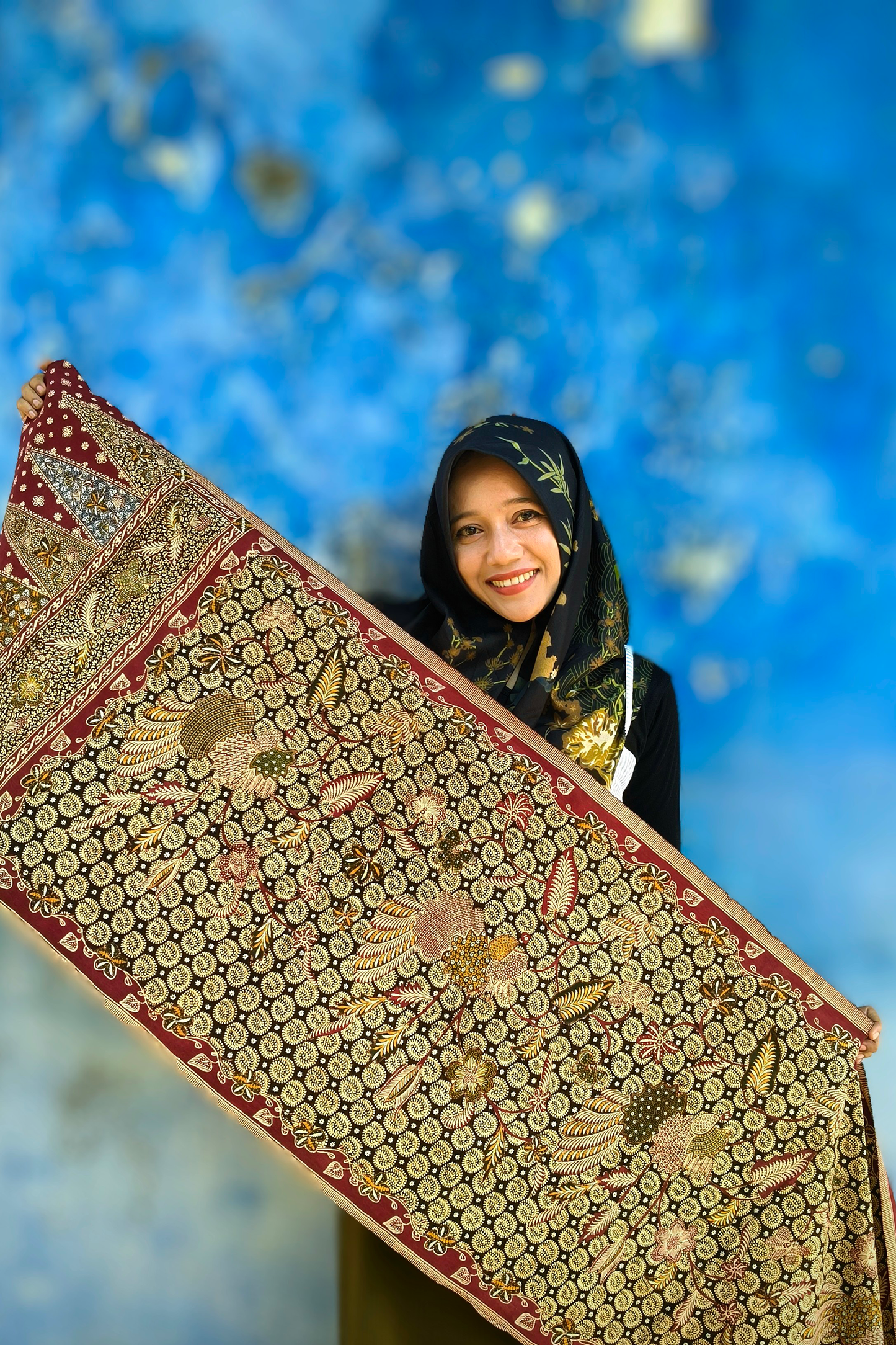
Ibu Khusnul Mubarokah
IBU KHUSNUL MUBAROKAH — SELENDANG KAWUNG ENDHOG
IBU KHUSNUL MUBAROKAH — SELENDANG KAWUNG ENDHOG
Couldn't load pickup availability
Ibu Khusnul Mubarokah
Born 1991, Batang, Indonesia
SELENDANG KAWUNG ENDHOG (2025)
100% Cotton, synthetic dyes
Hand-drawn wax resist on machine-woven cotton
250 × 52 cm
An eye-catching work rich in symbolism, showcasing both free-form organic flourish and geometric discipline.
The selendang shoulder cloth occupies a unique place in Javanese domestic and ceremonial life — worn as a fashion accessory, used to carry goods, and to cradle babies close to the body.
Made in the tiga negeri (three nations) colourway, the wax motifs were applied to the cloth three times over, once for each dye bath — a process demanding patience and precision. The three colours were each historically sourced from a different centre of Javanese batik production: red from Lasem on the north coast, blue from Pekalongan, and brown from Solo.
The badan (body of the cloth) is composed of the kawung endhog design — a geometric pattern of evenly spaced ovals made from organic spirals. Kawung refers to the fruit of the sugar palm; the motif is said to symbolise the four elements — wind, water, fire and earth — and our origins within them. Endhog means egg, the oval forms evoking the renewal of life. One of the oldest motifs in Javanese batik, kawung appears in the stone reliefs of Hindu and Buddhist temples and was historically one of the larangan — forbidden patterns reserved for the royal courts. Filling the spaces between the ovals are tiny kembang mlati (jasmine flowers) — sacred in Javanese ceremony and associated with purity and sincerity.
The foreground features four stylised manuk merak (peacocks) composed from feather-like leaves and flowers in the samaran style — never depicted whole, in keeping with the Rifa'iyah Sufi principle that living creatures must not be fully shown unless the artist can also grant them a soul. The peacock is the king of birds in Javanese and Chinese-influenced coastal batik, associated with beauty, grace, prosperity and good fortune.
The kepala (head sections) at each end feature very detailed tumpal — upward-pointing triangles symbolising creation and the sacred mountain peaks — filled with sasek (fern-like curling forms), geometric designs and flowers, with star-like configurations along the outer lengths suggesting the celestial horizon. The body is bordered by undulating vines.
Ibu Khusnul Mubarokah (Mbak Mila)
Mbak Mila is the daughter of batik artist and trader Ibu Istikomah. She rarely finds time to make batik today but is incredibly proud of this work, which she believes is her finest.